




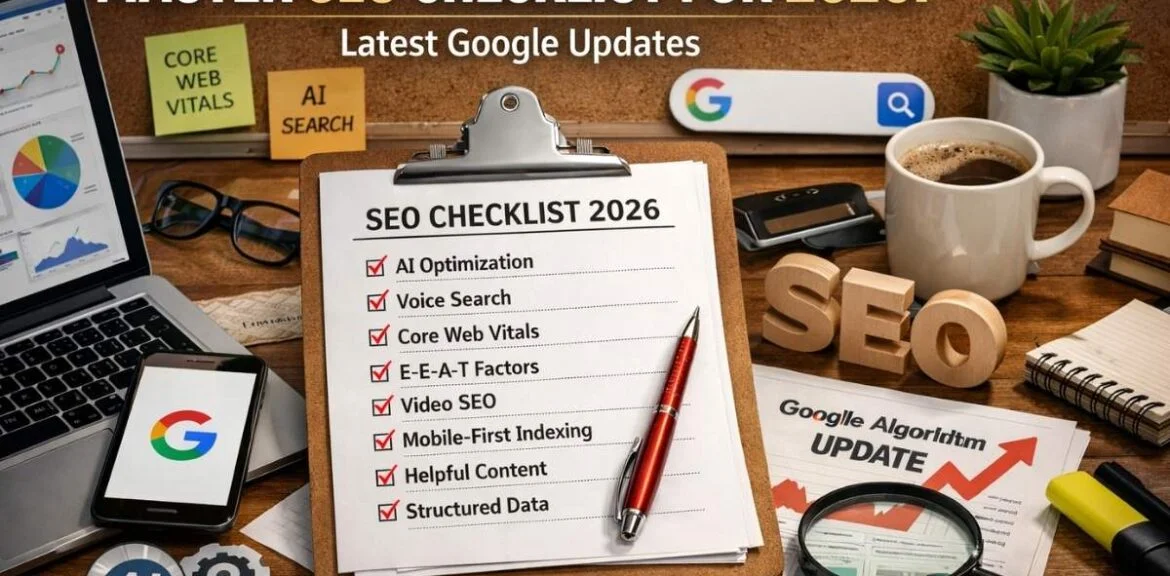

The digital landscape has evolved dramatically, and if you’re still using SEO tactics from even two years ago, you’re already behind. As we navigate through the Master SEO checklist for 2026, search engines have become increasingly sophisticated, user experience has taken center stage, and the rules of the game have fundamentally changed.
Struggling to rank in 2026’s hyper-competitive, AI-driven search landscape? This comprehensive SEO checklist, inspired by cutting-edge trends and time-tested tactics, equips you with actionable steps to skyrocket your visibility. Backed by the latest Google updates and expert insights, follow these to future-proof your site.
But here’s the good news: despite all the complexity, SEO success still comes down to mastering the fundamentals while adapting to new realities. This comprehensive checklist will walk you through everything you need to know to dominate search rankings in 2026, whether you’re optimizing your first website or managing an enterprise-level SEO strategy.

Why This SEO Checklist for 2026 Matters More Than Ever
Before diving into the tactics, let’s address the elephant in the room. With the rise of AI-powered search, voice assistants, and evolving user behaviors, some have predicted that the Master SEO Checklist will become obsolete. Instead, it has become more critical and more nuanced than ever before.
Google processes over 8.5 billion searches per day, a number that continues to grow. Your potential customers are searching right now. The question is whether they’ll find you or your competitors. This checklist ensures you’re positioned to win that visibility battle.
Section 1: SEO Basics – Building Your Foundation
Set Up Google Analytics 4
Google Analytics isn’t optional anymore; it’s the foundation of understanding your SEO performance. GA4, which became the standard after Universal Analytics sunset, offers enhanced tracking capabilities that give you unprecedented insight into user behavior.
Action steps: Create your GA4 property, install the tracking code on every page of your website, set up conversion events for key actions like form submissions and purchases, and configure custom dimensions for deeper analysis. Link your GA4 property with Google Search Console for comprehensive data integration.
The data you’ll gather here informs every other decision in your SEO Checklist strategy. You’ll understand which pages drive traffic, where users drop off, which channels deliver the highest-quality visitors, and how organic search contributes to your bottom line.

Set Up Bing Webmaster Tools
While Google dominates the search market share, Bing powers approximately 12 billion searches monthly and integrates with Microsoft’s AI assistants. More importantly, Bing’s webmaster tools often provide clearer, more actionable feedback than Google Search Console.
Action steps: Create your Bing Webmaster Tools account, verify your website ownership, submit your sitemap, and review the SEO Checklist reports and recommendations Bing provides. Pay special attention to their site scan tool, which identifies technical issues that might affect both Bing and Google rankings.
Generate and Submit a Sitemap
Your sitemap is essentially a roadmap that tells search engines which pages on your site matter and how they’re organized. SEO Checklist for 2026, with websites becoming increasingly complex and dynamic, a properly structured sitemap is non-negotiable.
Action steps: Generate an XML sitemap that includes all important pages while excluding thin content, duplicate pages, and pages blocked by robots.txt. Include key metadata like last modification dates and update frequency. Submit your sitemap through Google Search Console and Bing Webmaster Tools, then add the sitemap location to your robots.txt file.
For large sites, consider creating multiple sitemaps organized by section, and use a sitemap index file to keep everything organized. Update your sitemap automatically whenever you publish new content.
Set Up Google Search Console
Google Search Console is your direct line of communication with Google. It shows you how Google sees your site, which queries trigger your listings, technical errors that need fixing, and manual actions that might be suppressing your visibility.
Action steps: Add and verify your property in Search Console (add both www and non-www versions, plus the domain property for complete coverage), submit your sitemap, monitor the coverage report for indexing issues, and check the Core Web Vitals report regularly. Set up email alerts so you’re notified immediately when Google detects critical issues.
Review your search performance data weekly to identify trending keywords, pages losing visibility, and opportunities for optimization.
Section 2: Keyword Research – Finding Your Target
Find Your Main Keyword
Every page needs a primary focus keyword that captures the main search intent. This is the term you most want to rank for, the phrase that best describes what the page offers, and the foundation upon which you’ll build your content strategy.
Action steps: Use keyword research tools like Ahrefs, SEMrush, or Google’s Keyword Planner to identify keywords with substantial search volume that align with your business objectives. Analyze the search intent behind each keyword by examining current top-ranking pages. Consider the competition level and whether you can realistically rank for highly competitive terms or should target more specific variations first.
Your main keyword should have a clear commercial or informational intent that matches what your page delivers. A mismatch between search intent and page content is one of the fastest ways to tank your rankings in 2026.

Find Long-Tail Keyword Variations
Long-tail keywords are more specific phrases that typically have lower search volume but higher conversion rates. They’re the secret weapon of a successful SEO Checklist and strategy because they’re easier to rank for and attract users with clearer intent.
Action steps: Start with your main keyword and identify questions people ask around that topic, specific problems they’re trying to solve, and variations that include modifiers like “best,” “how to,” “near me,” or specific years. Use tools like AnswerThePublic, Google’s “People Also Ask” boxes, and your site’s internal search data to uncover these opportunities.
Create a comprehensive keyword map that assigns specific long-tail variations to different pages and sections of your content. This prevents keyword cannibalization while maximizing your topical coverage.
Research and Identify Competitors’ Related Keywords
Your competitors have already done keyword research, built content, and earned rankings. By analyzing their keyword profiles, you can identify gaps in your own strategy, discover profitable keywords you’ve overlooked, and understand what’s required to compete effectively.
Action steps: Use competitive analysis tools to identify your top 5-10 organic search competitors (not necessarily your business competitors), export their ranking keywords, and filter for relevant opportunities where they rank, but you don’t. Look for patterns in their keyword strategy, identify content gaps you can fill better, and analyze the backlink profiles of their top-performing pages.
This intelligence allows you to leapfrog competitors by creating more comprehensive content that targets keyword clusters they’ve missed or covered inadequately.
Section 3: Content Strategy – Creating Assets That Rank
Write a Grabbing Intro
Your introduction determines whether visitors stay or bounce, which directly impacts your rankings. Search engines & SEO Checklist track engagement metrics, and a compelling intro that hooks readers immediately signals quality content.
Action steps: Start with a hook that addresses the reader’s pain point or promises a clear benefit, establish credibility early, provide a brief preview of what the content delivers, and keep your intro concise yet compelling. Avoid generic statements and get to the value proposition quickly.
In 2026, users have endless options and diminishing patience. Your intro has approximately 5-8 seconds to convince them they’re in the right place.
Add a Table of Contents
For longer content, a table of contents dramatically improves user experience by allowing readers to navigate directly to the sections most relevant to them. It also creates jump links that can appear in search results, increasing your click-through rate.
Action steps: Create a clickable table of contents near the top of long-form content, use clear, descriptive labels for each section, implement jump links using HTML anchor tags, and ensure the TOC is mobile-friendly. Consider using a sticky or expandable TOC for very long articles.
Search engines can extract these jump links to create sitelinks in search results, giving your listing more visibility and real estate in the SERPs.
Grab Attention with Bold
Strategic use of bold text helps readers scan your content efficiently, emphasizing key points and making important information stand out. This improves readability and engagement, both of which are ranking factors.
Action steps: Bold important keywords naturally within your content (without over-optimizing), highlight key takeaways and action steps, emphasize statistics and data points, and use bold to create visual hierarchy. Avoid bolding entire sentences or paragraphs, which dilutes the effect.
Remember that bold is for emphasis, not decoration. Use it purposefully to guide readers to your most valuable insights.

Use Headings and Subheadings for Hierarchy
Proper heading structure (H1, H2, H3, etc.) is both a technical SEO Checklist requirement and a user experience necessity. It helps search engines understand your content organization while making it easier for readers to navigate and comprehend your material.
Action steps: Use exactly one H1 tag per page containing your primary keyword, organize main sections with H2 tags that include relevant keyword variations, use H3 tags for subsections that support your H2 content, and maintain logical hierarchy (never skip heading levels). Include keywords naturally in headings without forcing them.
Well-structured headings can generate featured snippets, enable voice search results, and improve your chances of ranking for multiple keyword variations on a single page.
Section 4: Technical SEO Checklist – The Engine Under the Hood
Ensure Website Is Mobile-Pages Friendly
Mobile-first indexing is now the default for all websites. Google predominantly uses the mobile version of your content for indexing and ranking, making mobile optimization absolutely critical in 2026.
Action steps: Implement a responsive design that adapts to all screen sizes, test your site using Google’s Mobile-Friendly Test tool, ensure touch elements are appropriately sized and spaced, optimize tap targets to prevent accidental clicks, and verify that mobile users can access all important content without obstacles like intrusive interstitials.
Page speed on mobile devices is particularly critical. Compress images aggressively, minimize code bloat, leverage browser caching, and consider implementing AMP for content-heavy pages if appropriate for your business model.

Ensure Site Is Indexed
Having great content means nothing if search engines can’t find and index it. Indexation problems are among the most critical yet frequently overlooked SEO issues.
Action steps: Check your robots.txt file to ensure you’re not accidentally blocking important pages, verify that important pages aren’t using noindex tags, submit your sitemap to search engines, use the URL Inspection tool in Search Console to check specific pages, and monitor the coverage report for indexation errors.
For new pages, use Google Search Console’s request indexing feature to expedite the process. For large sites, ensure your internal linking structure allows crawlers to discover all important pages efficiently.
Ensure URL Structure Is SEO Friendly
Your URL structure impacts both user experience and search engine understanding. Clean, descriptive URLs rank better and receive more clicks than cryptic strings of numbers and parameters.
Action steps: Use short, descriptive URLs that include your target keyword, separate words with hyphens rather than underscores, use lowercase letters consistently, avoid unnecessary parameters and session IDs, and implement a logical hierarchical structure that reflects your site’s organization.
For established sites, be cautious when restructuring URLs. Always implement 301 redirects from old URLs to new ones to preserve link equity and prevent broken links.
Section 5: Off-Page SEO Checklist – Building Authority Beyond Your Site
Analyze Your Competitor’s Links
Backlinks remain one of the strongest ranking factors in 2026. Understanding where your competitors are earning links reveals opportunities for your own link-building efforts.
Action steps: Use tools like Ahrefs or Moz to analyze the backlink profiles of pages ranking for your target keywords, identify high-authority domains linking to multiple competitors, look for patterns in the types of content earning links (research studies, tools, guides), and create a target list of websites to approach for your own link-building campaigns.
Focus on quality over quantity. One link from a highly authoritative, relevant website is worth more than dozens of links from low-quality directories.
Turn Unlinked Mentions Into Links
Your brand likely gets mentioned online without receiving a backlink. These are easy link-building opportunities since the site already references you positively.
Action steps: Set up Google Alerts and use tools like Ahrefs Content Explorer or BuzzSumo to monitor brand mentions, identify unlinked mentions on quality websites, reach out with a friendly request to turn the mention into a link, and provide the exact anchor text and URL to make it easy for them.
This tactic works particularly well for brands with strong PR efforts that generate media coverage.
Share Your Content
Great content needs promotion to earn visibility, engagement, and backlinks. Passive publishing rarely succeeds in today’s competitive environment.
Action steps: Share new content across your social media channels with compelling copy tailored to each platform, email your subscriber list with context about why the content matters to them, reach out to industry influencers and journalists who might find your content valuable, participate in relevant online communities where your content adds value, and consider paid promotion for especially important pieces.
The initial engagement burst you create through promotion sends positive signals to search engines and increases the likelihood that your content gets discovered by potential link sources.
Set Up Google Business Profile
For local businesses and any company with a physical location, Google Business Profile (formerly Google My Business) is essential for local SEO and appearing in map results.
Action steps: Claim and verify your business listing, complete every section of your profile with accurate information, add high-quality photos of your business, products, and team, encourage customers to leave reviews and respond to all reviews promptly, post regular updates to keep your profile active, and ensure your NAP (Name, Address, Phone) information is consistent across all online directories.
Optimize your business description with relevant keywords while keeping it natural and customer-focused. Add specific services, business hours, and attributes that help customers understand what you offer.
Actionable Implementation Table
| Category | Key Action | Tool Recommendation | Expected Impact |
| Basics | Submit sitemap | Google Search Console | 20-30% faster indexing |
| Keywords | Long-tail research | Ahrefs | 2x traffic from intent matches |
| On-Page | Schema markup | Google’s Structured Data Tool | Rich snippets boost CTR 30% |
| Technical | Core Web Vitals | Page Speed Insights | Ranking boost for 80% sites |
| Off-Page | Competitor analysis | SEMrush | 50% more quality links |
| Content | E-E-A-T focus | Original human writing | Outranks AI by 2 positions avg |
This table distils the SEO checklist for quick wins—implement one row per week.
Bringing It All Together
SEO in 2026 requires a holistic approach. You can’t simply check boxes and expect results; you need to understand how these elements interconnect and support each other.
Start with the basics to build a solid foundation. A website with proper analytics, search console integration, and clean technical infrastructure is ready for growth. Move into keyword research to understand what your audience actually searches for and the intent behind those searches. Create exceptional content that serves that intent better than competing pages. Optimize the technical elements that allow search engines to crawl, understand, and rank your content efficiently. Then build authority through strategic off-page efforts that earn quality backlinks and brand mentions.
The businesses winning in search results aren’t necessarily those with the biggest budgets; they’re the ones executing these fundamentals consistently and comprehensively. They understand that SEO is a marathon, not a sprint, and that compound returns come from persistent, strategic effort.
Your Next Steps
Print this checklist and work through it systematically for your website. Don’t feel overwhelmed by tackling everything at once. Instead, prioritize based on your current weaknesses. If your technical infrastructure is solid but you lack quality content, focus there first. If you have great content but poor technical implementation, address those issues before creating more content.
Set up regular audits using this checklist to ensure you’re maintaining standards as your site evolves. SEO isn’t a one-time project but an ongoing process of optimization, testing, and refinement.
The search landscape will continue evolving, but the fundamental principles of providing value, earning authority, and creating excellent user experiences will remain constant. Master these elements, stay informed about industry changes, and commit to continuous improvement.
Your competitors are fighting for the same visibility you seek. The difference between appearing on page one versus page two can mean the difference between a thriving business and struggling to get noticed. This checklist gives you the roadmap; your execution determines the results.
Start today. Your future rankings depend on the actions you take right now.
About SEO in 2026: As search evolves with AI integration and changing user behaviors, these fundamentals become even more critical. Focus on creating genuine value, earning real authority, and delivering exceptional user experiences. That’s the formula for long-term SEO success.
Ready to dominate search rankings? Save this checklist and share it with your team. Comment below with which section you’ll tackle first, and let’s build a community of businesses winning in search together.


