


SEO alone will not be enough to win in the AI search era because visibility is shifting from “10 blue links” to AI-generated answers that favour trusted entities, structured data, and brands that speak the language of machines as much as humans and era of SEO AI Search is the best way to grab more visibility. The real winners in 2026 will be those who integrate SEO, GEO (Generative Engine Optimization), and AEO (Answer Engine Optimization) into one human‑first, AI‑fluent strategy.
LinkedIn Hook / Description (use as intro snippet):
AI search is quietly stealing your clicks before they ever reach your website. You can have perfect on‑page SEO, a wall of backlinks, and still be invisible inside AI Overviews, ChatGPT answers, and Perplexity citations. In 2026, the brands that win will be the ones that stop playing only the Google game and start optimizing for the AI engines that now sit between your content and your customer.
From blue links to AI answers
For 20 years, SEO success meant ranking on page one and competing for a larger share of the click-through traffic. Today, that pie is shrinking fast as AI systems answer users directly without requiring a click at all. Over 65% of searches already end without a single website visit, and AI chatbots plus AI search experiences are accelerating that shift SEO AI Search.
Instead of scanning a list of links, people are asking Copilot, Perplexity, ChatGPT, and Google’s AI Overviews for direct, conversational answers. Those systems synthesise information from many sources, show only a handful of citations, and often satisfy the user without your page ever loading. In other words: traditional SEO is now necessary, but no longer sufficient.
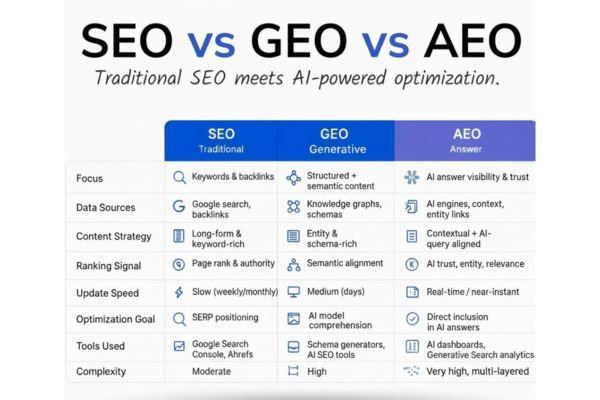
SEO vs GEO vs AEO in one picture: SEO AI Search
The visual you shared captures this evolution beautifully: SEO, GEO, and AEO as three overlapping but distinct layers of optimization. Traditional SEO is still about keywords, backlinks, and content quality, but GEO and AEO introduce two new battlegrounds: getting cited by AI engines and being selected as the direct answer.
Where SEO optimizes for search engines as we used to know them, GEO and AEO optimize for AI systems that compress the web into one synthesized response. If you are only playing the old game—title tags, meta descriptions, and link building—you are competing for visibility in a shrinking real estate while ignoring the new, much louder stage.
Key differences at a glance: Top Advantage of SEO AI Search
Here is a simple way to see how the three approaches differ and why all three are needed in 2026.
| Dimension | SEO (Traditional) – “Be found” | GEO (Generative) – “Be cited” | AEO (Answer) – “Be the answer” |
| Primary focus | Keywords, backlinks, page authority | Structured, semantic, entity‑rich content | Clear, concise, question‑focused answers |
| Main data sources | Web pages, links, technical SEO signals | Knowledge graphs, schemas, high‑quality corpora | Snippets, FAQs, voice queries, conversational logs |
| Main ranking signal | Relevance + authority (EEAT, backlinks) | Trustworthiness as a source for LLMs, semantic alignment | Ability to directly satisfy intent in one answer |
| Update speed | Slow to medium (indexing, re‑crawls) | Medium (model updates, embeddings refresh) | Near real‑time (AI answer surfaces, snippet swaps) |
| Optimization goal | Higher positions in organic SERPs | Being cited or referenced inside AI‑generated answers | Being displayed as the standalone answer or top snippet |
Why SEO alone is losing leverage
There are three uncomfortable truths that most teams are discovering the hard way.
- Truth 1: Organic traffic is decoupling from organic visibility.
You can “rank” well in classic SERPs but still lose traffic because users never scroll past the AI Overview that answered their question. - Truth 2: AI engines don’t just read keywords; they model entities.
Large language models and knowledge graphs care deeply about who you are, how consistently you are described, and how you connect to other entities, not just what keywords appear on a page. - Truth 3: AI referrals are fewer but stronger.
When an AI assistant does send a user to your site, that user often has much higher purchase intent because the assistant has pre‑qualified and educated them first.
SEO is still the foundation—without crawlable, high‑quality content, nothing else works—but in the AI search era, it has become table stakes, not a differentiator.
GEO: training the machines to trust you
Generative Engine Optimization (GEO) asks a brutal question: if an AI assistant synthesized an answer to your topic right now, would it have any reason to quote or cite your brand? GEO is about deliberately shaping the signals those models use when they decide which few sources to pull into an answer.
GEO‑driven brands in 2026 are doing things differently.
- They build entity‑rich content, connecting products, people, locations, and concepts with clear relationships using schema markup, internal links, and consistent naming.
- They publish high‑signal “source documents”—definitive guides, data studies, FAQs, documentation—that models can safely rely on when answering complex queries.
- They monitor where and how often their brand is mentioned in AI responses to measure “share of voice” inside AI systems, not just in traditional SERPs.
In GE0, top rankings matter less than being recognized as the authority that powers the answer—even if users never see your URL explicitly.
AEO: designing content as an answer, not a page
Answer Engine Optimization (AEO) takes a more tactical angle: it focuses on how your content is structured so that AI systems can safely lift and display it as a direct answer. Think featured snippets, “People Also Ask” boxes, voice assistant replies, and AI Overview cards.
The best AEO practitioners in 2026 treat every key topic like a question waiting to be answered.
- They write question‑first headings (“How much does X cost in 2026?”) and follow with concise, 1–3 sentence answers before expanding with context.
- They use scannable blocks—bulleted lists, short paragraphs, tables—that map neatly to how AI engines prefer to extract information.
- They add structured data (FAQPage, HowTo, Product, Organization schema) so machines understand the type of answer being offered.
AEO is about becoming the safest, most precise, and easiest‑to‑reuse answer for a specific intent. In an AI‑first world, that is the content that surfaces again. And you must try SEO AI Search Era in 2026.
Who actually wins in 2026?
By 2026, the winners are not the brands with the most content or the biggest backlink profile—they are the brands that combine SEO, GEO, and AEO into one coherent strategy centred on real expertise. Their content is written by humans who know the subject deeply, then structured for machines that need to parse and trust it.
High‑performing brands share several traits.
- Deep, demonstrable expertise. They prioritize subject‑matter experts, original research, and unique points of view, which aligns strongly with the rising importance of EEAT as a ranking factor.
- Entity‑first thinking. They invest in crisp brand, product, and author entities that are defined consistently across their site, social profiles, and external directories.
- AI analytics, not just web analytics. They track citations, mentions, and appearance rates inside AI answers the same way they once watched impressions and CTR in Search Console.
In other words, the winners build brand gravity—a level of authority so strong that both search engines and AI assistants naturally orbit around their content.
How to pivot your strategy now
If your current strategy is still 90% “classic SEO,” here is how to start shifting without burning everything down.
- Audit your content for AI‑readiness.
Identify your highest‑value topics and ask: do we provide a definitive, clearly structured answer for each of them? If not, prioritize rewriting top pages with question‑first headings, concise summaries, and clear takeaways. - Map and strengthen your entities.
Document your core entities (brand, products, services, people, locations) and ensure they are consistently described across your website, LinkedIn pages, directories, and press mentions. Use schema markup to expose those entities to machines. - Create “source of truth” assets.
Develop long‑form guides, benchmark reports, comparison tables, and FAQs that can act as training data for AI systems—content with clear definitions, numbers, and frameworks. These become your GEO powerhouses. - Design content modules that can be reused.
Structure important concepts as small, self‑contained blocks: short definitions, numbered how‑to steps, pros/cons lists, and verdict paragraphs. These are easy for AI engines to quote accurately. - Monitor your AI footprint.
Regularly test important queries in AI assistants and AI search experiences to see if and how your brand appears. Treat missing citations as opportunities to strengthen clarity, structure, or authority on those topics.
Why does human‑written still beat mass‑generated content
There is a tempting shortcut in 2025–2026: generate thousands of AI‑written posts and pray some of them rank. The problem is that AI search systems are getting better at detecting shallow, derivative content and rewarding clear expertise, original insight, and strong opinions. Many practitioners are already seeing human‑led content outperform generic AI output over the long term.
Human‑written content has three advantages machines struggle to fake.
- Original perspective. Practitioners can share lived experiences, mistakes, internal data, and nuanced context that generic models simply do not have.
- Strategic narrative. Humans can craft a story that aligns with brand positioning, buyer psychology, and market timing rather than just answering a prompt.
- Ethical and brand‑safe judgment. Humans can decide what not to publish, when to simplify, and when to challenge conventional wisdom in ways that build trust.
In the AI search era, AI can help you draft, outline, and research—but it is the human editorial layer that turns content into a durable asset AI systems trust enough to reuse.
The Evolution Is Clear—But the Path Forward Isn’t Simple: SEO AI Search Era
Looking at the progression from SEO to GEO to AEO, you can see a clear trajectory. Each stage builds on the previous one but requires fundamentally different approaches.
SEO is about visibility in search results. It’s foundational and still necessary. You need strong traditional SEO to build domain authority, establish your presence, and create the baseline content that everything else builds on.
GEO is about machine comprehension. It’s the bridge strategy that helps AI engines understand your content, parse your expertise, and recognize your authority on specific topics. It requires technical sophistication and structured data implementation.
AEO is about AI trust and citation. It’s the advanced strategy that positions you as the authoritative source AI engines reference when generating answers. It requires deep understanding of how AI models work, what signals they trust, and how to structure content for optimal AI comprehension.
The relationship isn’t linear—it’s cumulative. You don’t abandon SEO when you adopt GEO. You don’t stop doing GEO when you focus on AEO. Each layer builds on the previous one.
Think of it like building a house. SEO is the foundation—solid, necessary, but not sufficient on its own. GEO is the framework and structure—it gives shape and makes the house functional. AEO is the smart home system—it makes everything responsive, connected, and optimized for the future.
What Winners Are Doing Differently Right Now
The businesses that are thriving in this transition aren’t waiting for perfect clarity. They’re adapting, experimenting, and building multi-layered strategies.
Here’s what I’m seeing from the winners:
They’re structuring content for AI comprehension. Instead of just writing blog posts, they’re implementing comprehensive schema markup, creating clear entity definitions, and building content that maps to knowledge graphs.
They’re focusing on E-E-A-T at scale. Experience, Expertise, Authoritativeness, and Trust aren’t just SEO buzzwords anymore—they’re the core signals AI engines use to evaluate sources. Winners are demonstrating expertise through author credentials, original research, verifiable data, and consistent authority signals.
They’re monitoring AI citation. They’ve implemented tracking systems to monitor when and how AI engines reference their content. They’re analyzing which content gets cited, understanding why, and replicating those patterns.
They’re creating answer-first content. Instead of keyword-first content, they’re writing for natural language queries. They’re anticipating the questions people ask conversational AI and structuring answers that are clear, direct, and authoritative.
They’re building entity authority. They’re establishing themselves and their brands as recognized entities across the web—through consistent NAP (Name, Address, Phone) information, Wikipedia presence, knowledge panel optimization, and brand mentions across authoritative sources.
They’re embracing real-time optimization. They’re not waiting months to see results. They’re testing, measuring, and adapting based on how AI engines respond to their content.
The Uncomfortable Truth About 2026
By 2026, the digital marketing landscape will be unrecognizable to those still clinging to 2020 strategies.
AI-powered search will dominate. Traditional search engines will still exist, but AI overviews, conversational answers, and synthesized responses will be the primary user experience.
Zero-click searches will become the norm, not the exception. Getting users to click through to your website will be harder than ever.
The businesses that survive and thrive will be those that understand a fundamental truth: visibility isn’t about rankings anymore. It’s about trust. It’s about being the source AI engines cite. It’s about establishing such clear authority that when someone asks a question in your domain, your content is the answer.
Your Action Plan: Start Today, Not Tomorrow
If you’re feeling overwhelmed, start here. You don’t need to master everything at once, but you need to start moving.
Phase 1: Audit Your Current State
- How much of your traffic comes from traditional organic search?
- How is your content currently structured?
- Do you have comprehensive schema markup?
- Are you monitoring AI engine citations?
- What does your E-E-A-T signal profile look like?
Phase 2: Implement GEO Fundamentals
- Add structured data to your key content
- Create entity-focused content clusters
- Build comprehensive topic coverage
- Implement schema markup for your organization, authors, and content
Phase 3: Begin AEO Optimization
- Rewrite key content with AI query alignment
- Create clear, attributable answer formats
- Monitor AI engine citations
- Build entity authority across the web
- Focus on real-time, authoritative content
Phase 4: Measure and Iterate
- Track AI citation frequency
- Monitor branded search trends
- Measure trust signals
- Analyze zero-click search impact
- Adjust strategy based on AI engine behavior
What this means for you as a marketer or founder
If you are leading marketing, growth, or SEO, your job description is quietly changing. You are no longer optimizing only for algorithms that rank pages but for AI systems that explain the world to your customers. Your brand will either be part of those explanations—or it will disappear behind the opaque wall of an AI answer.
That means your content strategy must operate on three levels at once.
- SEO: Make it easy for search engines to crawl, index, and understand your content so you still win where traditional search matters.
- GEO: Make it attractive for AI models to rely on you as a trusted source when they synthesize answers.
- AEO: Make it trivial for AI surfaces to extract and display your content as a complete, ready‑to‑use answer.
Brands that embrace this triple‑layered approach now will own the conversation in 2026 while competitors wonder why their immaculate SEO dashboards are no longer translating into pipeline.
“SEO is no longer the whole game. In 2026, your visibility will depend on how well AI systems can understand, trust, and reuse your content—whether or not anyone ever clicks a link. In this article, I break down SEO vs GEO vs AEO, show why SEO AI Search is rewriting the rules, and share a practical roadmap for winning when answers matter more than rankings.