




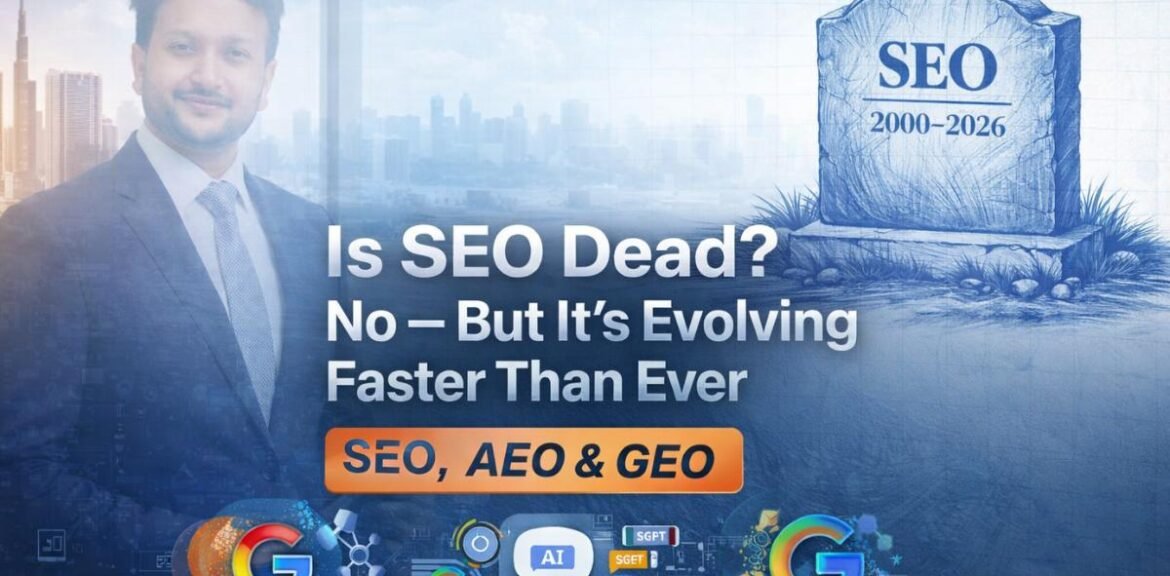

Is SEO dead? SEO is not dead. But if you’re running the same playbook you were using in 2018, your strategy might as well be buried alongside the gravestone in that post.
Every year, someone declares the death of SEO. In 2012, it was social media. In 2016, it was voice search. In 2020, it was a video. Now, in 2026, it’s AI.
And every single time, the obituary turns out to be wrong.
Is SEO dead? No, what is happening right now is that SEO evolves fast. It sheds the tactics that no longer serve it and absorbs the new signals that matter. The fundamentals stay the same: people search for answers, and search engines try to provide the best ones. What changes is how that discovery happens and what “best” looks like to the algorithms reading your content.
In 2026, winning visibility online means understanding not one, but three layers of discovery: SEO, AEO, and GEO. Brands that master all three are the ones getting found everywhere. Brands still optimising only for keywords are leaving enormous visibility on the table. That’s where modern SEO strategies in 2026 come in – not just to rank higher, but to fuel SEO services for business growth.
Here’s everything you need to know.
First: Let’s Settle the “SEO Is Dead” Debate Once and For All
Google processes over 8.5 billion searches every single day. Organic search remains the single largest driver of website traffic across industries, outperforming paid ads, email, and social combined for most businesses. Companies that rank well on Google still acquire customers at a scale and cost efficiency that other channels rarely match.

So, No SEO is not dead. It is, however, the most misunderstood discipline in digital marketing. And most “SEO is dead” takes come from one of two sources: either a major algorithm update caused rankings to drop (which happens, and always will), or a discovery channel emerged that people didn’t know how to factor in. and if you more than an SEO for complete marketing proposal so, contact us for online marketing agency in Dubai is a company that helps businesses create, plan, and manage digital marketing strategies. Their goal is to attract more customers through online channels. These may include search engines, websites, email, social media platforms, and mobile apps.
Both of those things are true right now. Google’s Helpful Content updates have hammered low-quality, keyword-stuffed content. AI tools like ChatGPT and Perplexity are capturing search queries that once went to Google. And zero-click results – where users get their answer directly on the search results page without visiting any website – are at an all-time high.
The question is no longer “How do I rank on Google?” The question is “How do I get found – across search engines, AI tools, featured answers, and every platform where my audience is looking?”
That’s a bigger question. And answering it requires a bigger framework. Enter SEO, AEO, and GEO.
The Three Layers of Visibility: SEO, AEO, and GEO
| SEO | AEO | GEO | |
| Full name | Search Engine Optimisation | Answer Engine Optimisation | Generative Engine Optimisation |
| Goal | Rank higher on Google | Become the direct answer | Get cited by AI tools |
| Outcome | More clicks to your website | Brand authority via featured answers | AI recommends your brand |
| Key signal | Keywords + backlinks + technical | Schema + answer structure | Originality + authority + crawlability |
Layer 1: SEO – The Foundation That Never Goes Away
Search Engine Optimisation is the practice most marketers are familiar with: ranking your web pages in Google by targeting keywords, earning quality backlinks, and ensuring your technical infrastructure is clean, fast, and crawlable.
This still works. This still matters enormously. But what SEO means in practice has fundamentally shifted.
Old SEO vs New SEO
Old SEO focused on: keyword density and exact-match placement, backlink quantity over quality, page speed benchmarks, domain authority scores, and monthly search volume as the primary planning signal.
New SEO focuses on: answer quality and content completeness, topic authority and entity recognition, schema markup and structured data, cross-platform credibility signals, and content recency.
Google’s E-E-A-T framework – Experience, Expertise, Authoritativeness, Trustworthiness – now sits at the heart of how content is evaluated. Pages written by identifiable experts, citing credible sources, updated regularly, and genuinely serving user intent rank significantly better than thin, keyword-optimised content. In fact, thin content no longer just underperforms. It actively suppresses your entire domain’s authority.
The goal of new SEO isn’t just to rank higher. It’s to become the answer – the resource so comprehensive, so authoritative, and so clearly structured that Google has no choice but to feature it prominently.
And this is exactly where SEO begins to overlap with the next layer.
Layer 2: AEO – Optimising for the Answer, Not Just the Rank
Answer Engine Optimisation (AEO) is the practice of optimising your content to appear as a direct answer – without the user needing to click anything at all.
You’ve seen this in action. You type a question into Google, and a featured snippet appears above all the results, pulling an answer directly from a web page. Or the “People Also Ask” section expands with direct answers from various sources. Or Google’s AI Overview summarises the topic before you see a single blue link. Or Alexa reads out a result in response to a voice query.
All of these are AEO territory – and they represent a structural shift in how content is consumed online.
Why optimise for zero-click results? It sounds counterintuitive. If the user doesn’t click through to your site, what’s the value? The answer is brand authority at scale. When Google repeatedly surfaces your content as the definitive answer to questions in your industry, your brand becomes synonymous with expertise. When those same users are ready to buy or need deeper information, they already know and trust your name.
What AEO requires in practice:
- Direct, concise answers to specific questions in the first 1–2 sentences of each section
- FAQ sections written in the exact language your audience uses when searching
- Schema markup: FAQ schema, HowTo schema, Article schema – all signal to Google the structure of your content
- Short, scannable paragraphs that make it easy for algorithms to extract and feature your answers
- Answer-first writing structure: state the conclusion, then support it
AEO is especially critical as voice search continues to grow. When someone asks a voice assistant a question, there is only one answer – not ten blue links. Being that one answer carries more value than ranking third on a results page.
In AEO, the outcome isn’t just a click. It’s trust. Your brand becomes the source Google trusts enough to surface front and centre, even without the user visiting your website.
Layer 3: GEO – Getting Found in AI-Generated Discovery
Generative Engine Optimisation (GEO) is the newest – and perhaps most disruptive – layer of visibility. It’s the practice of optimising your content to be cited, referenced, or summarised by AI-driven tools: ChatGPT, Perplexity, Google Gemini, Microsoft Copilot, and any other generative AI platform that synthesises information from across the web.
Think about how your own search behaviour has changed. When you need a quick explanation, do you always go to Google? Or do you sometimes ask an AI tool directly? More and more users are choosing the latter – and when they do, the AI doesn’t return a list of ten links. It generates a synthesized answer, drawing from multiple sources, and cites the ones it found most credible and useful.
Those citations are the new page-one rankings. And GEO is the discipline of making sure your brand is the one being cited.
How to get found in LLMs: the four pillars
1. Crawlable – AI models need to access your content in the first place. That means AI crawlers are not blocked in your robots.txt, your site loads fast with clean HTML, and your sitemaps are current. Crawlability is the baseline. But crawlable alone doesn’t mean visible.
2. Understandable – AI models need to make sense of what your content says and extract the relevant parts. Schema markup is essential here. Clear headings, Q&A formatting, short paragraphs, and answer-first structure all help models identify, understand, and extract your content accurately.
3. Trustworthy – AI tools are trained to prioritise credible sources. Quality backlinks from authoritative domains, real author bios with visible credentials on every page, Wikipedia entries, Wikidata presence, and claimed Google Knowledge Panels all contribute to the entity authority signals that AI models use to assess trustworthiness.
4. Citation-worthy – This is the hardest and the most important. AI tools cite sources that offer something genuinely unique: original research, proprietary data, frameworks that don’t exist elsewhere, or answers to specific questions that are better than anything else available. Generic, surface-level content won’t get cited – regardless of how well structured it is. You need to create something worth referencing.

Why SEO, AEO, and GEO Work Together – Not Against Each Other
Here’s where many marketers go wrong: they treat SEO, AEO, and GEO as separate strategies competing for budget and attention. They’re not. They’re complementary layers that reinforce each other in a compounding loop.
Strong SEO builds the technical and authority foundation that makes AEO and GEO possible. A fast, well-structured website with quality backlinks is far more likely to win featured snippets and AI citations.
Strong AEO means your content is structured for extraction – which is also exactly what AI models look for. The same clear, answer-first writing that wins a Google featured snippet is what Perplexity or ChatGPT looks for when generating a synthesised response.
Strong GEO builds brand authority that feeds back into traditional SEO signals. When AI tools consistently cite your brand, users start searching for your brand name directly. That branded search volume signals to Google that you’re a recognised authority – which improves your organic rankings further.
The loop is self-reinforcing. Invest in all three layers and they compound. Neglect any one of them and you leave a channel of discovery open for a competitor to claim.
What This Means for Your Content Strategy Right Now
The practical implication is this: if your content is still built primarily around keywords, you are optimising for one layer out of three.
Building content for all three layers means asking different questions before you write anything:
- What keyword is this targeting? (SEO layer)
- What specific question does this answer, and can Google extract that answer directly? (AEO layer)
- What unique insight, data point, or framework does this provide that an AI tool would want to cite? (GEO layer)
It also means rethinking content depth. Thin, surface-level content doesn’t cut it anymore – not for Google’s quality signals, not for featured snippets, and especially not for AI citation. Content that comprehensively covers a topic, answers multiple related questions, and provides a genuine expert perspective is the content that wins across all three layers simultaneously.
And it means taking authority-building seriously as a long-term investment: schema markup, author credentials, Wikipedia entries, Knowledge Panel claims, high-authority backlinks. These aren’t nice-to-haves. They are the infrastructure of visibility in an AI-mediated search landscape.

The Mindset Shift That Separates Winners from the Rest
For most of SEO’s history, the goal was positional: rank higher than your competitors. Get to position one. Stay at position one. It was a ranking game.
The new game is different. The goal isn’t just to rank – it’s to be the answer. To be the source that AI tools trust enough to cite. To be the brand that appears in featured snippets, voice responses, AI-generated overviews, and organic results simultaneously, across multiple platforms.
That requires a fundamentally different aspiration. Less keyword manipulation, more genuine expertise. Less technical gaming, more authoritative content creation. Less traffic hacking, more trust building over time.
The brands investing in real authority – through original research, consistent publishing, transparent credentials, and genuinely useful content – are the ones that survive every algorithm update, every AI integration, every new discovery channel. Because the underlying goal of every search system, whether human or AI, has always been the same: connect people with the most credible, most useful answer.
Build content that deserves to be that answer, and you’ll be found – regardless of how the technology changes.
The Bottom Line
Is SEO dead? No. Not even close.
But SEO in 2026 looks very different from SEO in 2016. The brands winning today aren’t just optimising for keyword rankings. They’re building content that works across all three layers of visibility – SEO, AEO, and GEO – simultaneously.
They’re creating content that ranks on Google, gets featured as a direct answer in search results, and gets cited by AI tools when someone asks a question their brand is best placed to answer.
That is the new standard. Not just rank. Be the answer.
If your content strategy is still built only for keywords, now is the time to evolve. The shift is not complicated – but it does require intentionality. Start with the three questions above. Build content that deserves to be cited. Take your authority signals seriously. And stop treating SEO, AEO, and GEO as separate departments.
SEO isn’t dead. It’s just becoming smarter. And the smartest brands are already adapting.
Frequently Asked Questions
Is SEO dead in 2026?
No. SEO is not dead. Google processes billions of searches every day, and organic search remains the largest single source of website traffic for most businesses. What has changed is how SEO works: today it rewards genuine expertise, authoritative content, and clear structure far more than keyword density or backlink volume.
What is the difference between SEO, AEO, and GEO?
SEO (Search Engine Optimisation) helps your pages rank higher in Google search results. AEO (Answer Engine Optimisation) helps your content appear as a direct answer in featured snippets, People Also Ask sections, and voice search results. GEO (Generative Engine Optimisation) helps your content get cited by AI tools like ChatGPT, Perplexity, and Google Gemini when they generate answers.
How do I optimise for AI search engines?
To be found in AI-generated results, your content needs to be crawlable (accessible to AI bots), understandable (structured with clear headings and schema markup), trustworthy (credible backlinks and real author credentials), and citation-worthy (original, unique content that answers specific questions better than anyone else).
Do I need to choose between SEO, AEO, and GEO?
No – and you should not try to. The three layers reinforce each other. Strong SEO builds the authority foundation for AEO and GEO. AEO structure improves AI citation rates. GEO visibility drives branded search volume that boosts organic rankings. They work best as a unified strategy.
What type of content wins across all three layers?
Content that is comprehensive, expert-led, answer-first in structure, regularly updated, and backed by original data or unique frameworks. Generic, thin, or keyword-stuffed content fails across all three layers. Depth, clarity, and genuine authority are what win in 2026.
Tags: SEO | AEO | GEO | Digital Marketing | Content Strategy | AI Search | SEO 2026 | Search Engine Optimisation | Generative Engine Optimisation


